
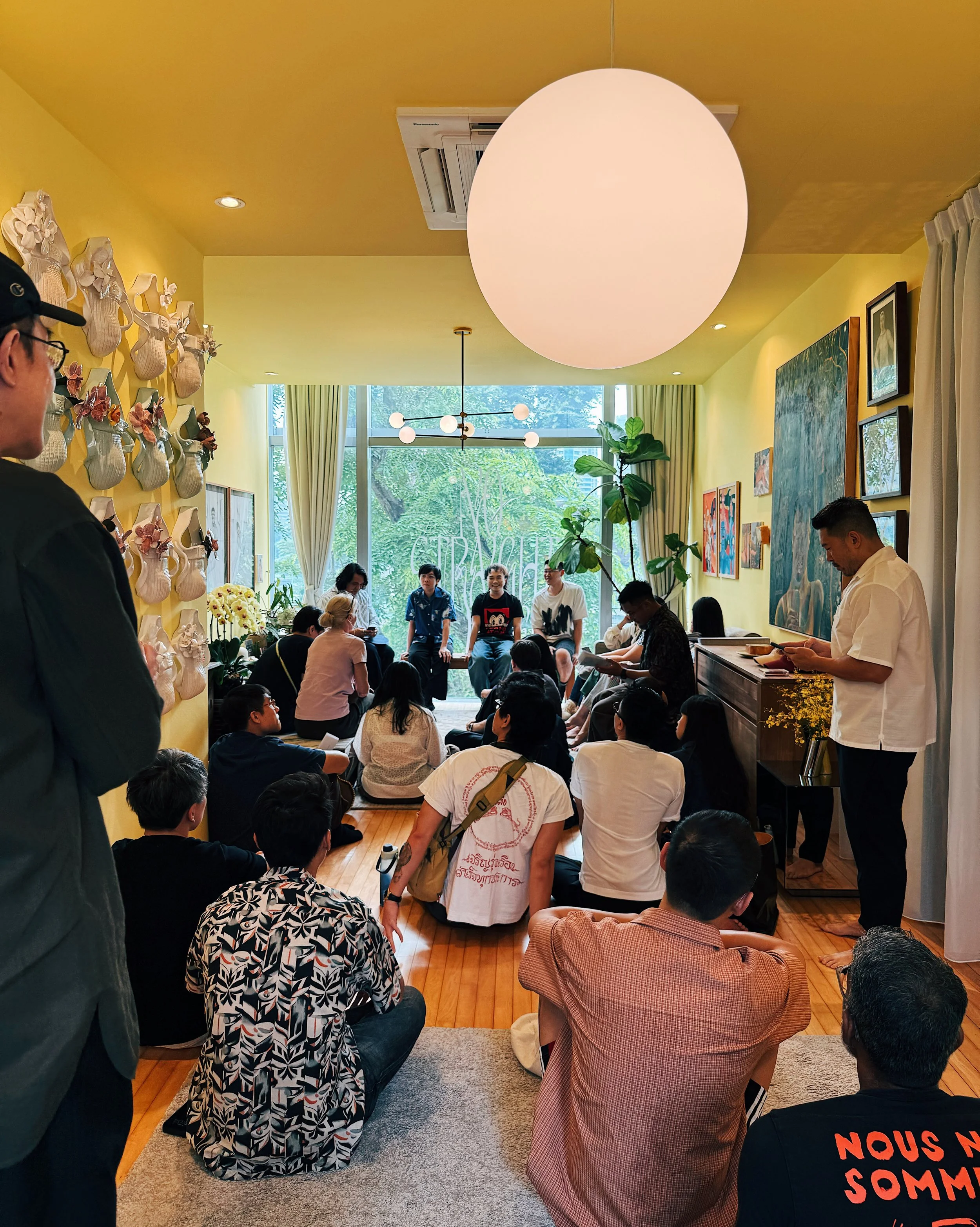
01
to ARMIN MAYER
A list containing 16 oxymorons:
Chrystal Ho: “Are you angry, I want to ask… for even after you’re recognised / as the first woman in the world to breed a hybrid orchid / you’re still known on the internet as / ‘Agnes Joaquim, Gardener’.”
Juliet: “O, that deceit should dwell / In such a gorgeous palace!”
Tough love
Former Prime Minister Lee Hsien Loong: “You know our rules in Singapore. Whatever your sexual orientation, you are welcome to come and work in Singapore.”
Soft rock
Thio Li Ann: “Anal-penetrative sex is inherently damaging to the body and a misuse of organs, like shoving a straw up your nose to drink.”
Magical realism
Jul 14, 2014: “A lawyer representing Mr Lim and Mr Chee, argued in the Court of Appeal that Section 377A should be modified so that it does not apply to consenting adults and sexual acts done in private. / The lawyer said her clients were not seeking to change the constitution, but only to enforce it.”
Gerald Giam: “Mr Deputy Speaker, it is my sincere belief that retaining section 377A without enforcing it provides the best balance of the conflicting interests in our society. / I have come to agree with what the Prime Minister said in Parliament on 23 October 2007, when he explained that the Government was retaining section 377A but not proactively enforcing it. / This was, to quote the Court of Appeal, a ‘political compromise’ that was ‘conceived with the express intention of accommodating divergent interests, avoiding polarisation and facilitating incremental change.’”
Sundaresh Menon CJ (delivering the judgment of the Court of Appeal): “The merits of retaining s377A were subject to robust and lengthy debate in Parliament in 2007, culminating in a uniquely Singaporean resolution: a political compromise in which s377A would be retained because it was thought to bear important symbolic weight for the conservative mainstream in Singapore.”
Passion Made Possible
Grace Fu: “MND oversees land use planning & zoning, taking into account various demands and trade-offs across Government, including biodiversity. MSE does not have a mandate in these areas, even though these issues are considered alongside the climate agenda.”
Garden City
Romeo: “Feather of lead, bright smoke, cold fire, sick health, / Still-waking sleep that is not what it is!”
Lee Hsien Loong: “Hence even as we repeal s377A, we will uphold and safeguard the institution of marriage… However, as the law stands, this definition of marriage can be challenged on constitutional grounds in the courts, just like s377A has been challenged… We will therefore protect the definition of marriage from being challenged constitutionally in the courts.”
Hamlet: “So again good night / I must be cruel only to be kind.”
02
to NATHAN TAN
In an early explanatory note to the curator, the artist Nathan Tan said: “This work explores my identity as a queer individual who is also a devoted listener and fan of heavy metal music. While these identities are often perceived as contradictory, they have never conflicted for me. Heavy metal is frequently associated with hypermasculinity, strength, and aggression, while queerness is often stereotyped as feminine, soft, or delicate. I have never felt the need to choose between the two. I can be queer while listening to heavy metal, wearing a metal band T-shirt, and embracing the culture that comes with it.” Hey, Nathan, I want to say: I hear you. Every gay man in his youth chooses a diva to worship for the rest of his life, and if yours is Rob Halford, then so be it. I must confess, however, that the closest I’ve ever come to heavy metal was “Heavy Metal Lover”, a song by Lady Gaga that’s admittedly not so much about the genre, and more about having the hots for a metalhead. Anyway, Nathan: I must insist that I get you, I do: on Apple Music I have a playlist that I’ve been tending to over the years like a sourdough starter. It’s called “Solitude / Fortitude”, and is about all the discordant binaries that you insist on keeping close. Because Nathan, to me at least, the best song is a song that can help you find strength in sadness, because why the fuck else is music for, really. Because, Nathan: music builds stamina, and I know you know this too. Nathan, Nathan: my favourite songs are the ones without words; whose music videos have fireworks and, to quote Lorde, “a supercut of us!!”—songs that are preferably more than 3:30 long, and have what the best storytellers have insisted is a beginning / middle / end, a point of no return that causes the action to rise into a suitable climax that then allows our heroes / heroines to tumble and rumble on the way out. And so Nathan, bear with me: I know I just said I like songs without words, but do you also happen to love lyrics as much as I do? Allow me now to rank my top five lyrics of all time, in ascending order of Gay to Pretty Fucking Gay:
—Phoebe Bridgers: “Jesus Christ, I'm so blue all the time / and that's just how I feel / always have and I always will / I always have and always will”
—Bon Iver: “Would you really rush out? (For me now!)”
—This Mortal Coil: “Oh I want you / oh I want you / like a kangaroo”
—Fleetwood Mac: (screaming) “Time cast a spell on you / but you won't forget me! / Well, I know I could have loved you / but you would not let me! / I’ll follow you down / ’til the sound of my voice will haunt you! / You'll never get away from the sound / of the woman that loved you!”
—Cassandra Jenkins, in “Hard Drive”: “A security guard / stopped me to offer an overview on phenomenal nature. / She said, ‘Sculpture is not just formed from penetration / You see, men have lost touch with the feminine.’”
03
to IAN TEE
—I say: to name something is to perform an act of light.
—If you say so. And if it is not named?
—Then it remains in the dark. But they are still there, I assure you.
—What are you reading?
—Something. It has a story named “The Last Voyage”. Shall I tell you about it?
—Is it related to what we are talking about?
—In a way. It’s the only one of two stories featuring us, or people like us. It’s quite romantic: it’s out on the seas; it’s also very doomed.
—Oh?
—It’s a romance between Zheng He and an unnamed lover.
—Why is he unnamed?
—Because he’s Southeast Asian, I suppose. And so: a fantasy. And so: invisible. Even when Zheng He proclaims his “life is complete”, he quickly says, right after: “Every voyage, every journey, must come to an end.”
—And so it is doomed, like you say. Their love is consigned to a darker realm. In this realm, their desire can ony consume itself, because there’s nothing left to burn. / What about the other story?
—The other story?
—You said there were two stories featuring us, or people like us.
—Oh, yes, yes. The second story is even sadder, in a way. If you can think of one story as an arrow, shot across time, the story of the first hero soars from the past, and lands on the shores of the present, in which hero number two, an average Singaporean man, receives an invite to a gathering of gay men.
—Does he go?
—He goes. But then he reminds himself, and I quote: that “he was a husband and father—these roles were what mattered.” He chickens out.
—Does this Singaporean have a name?
—Yes. Liang. Which is to say: light.
—But he will never name himself a homosexual. And so he will never learn to step into himself.
—Oh, very good.
—Can I offer a metaphor as well? Like the stories, this one also comes in two.
—Shoot.
—Zheng He: “To love is to be vulnerable, to venture into unknown terrain, bracing yourself for the worst.” Liang: “His life was already set out before him, and there was nothing he could do to alter the course.”
04
to TIN NGUYEN
Tin Nguyen’s hands are things of beauty. Tin, I don’t just see you, I adore you somewhat: in no longer a rehearsal, together with the sunrise’s choreo (2025, 48x36 inches), we see the artist holding up a hand against the rising sun as its light peeks through a line of trees—a beautiful image, perfectly quotidian, the hand a topography of colour as earthen in shade as the trunks of the trees, as though it too had sprung from the grass, eager and grasping for the promise of daylight. But the image we see in no longer a rehearsal is made stranger, and a lot less straightforward, when we more closely observe the painting, and the way the objects fall into focus:
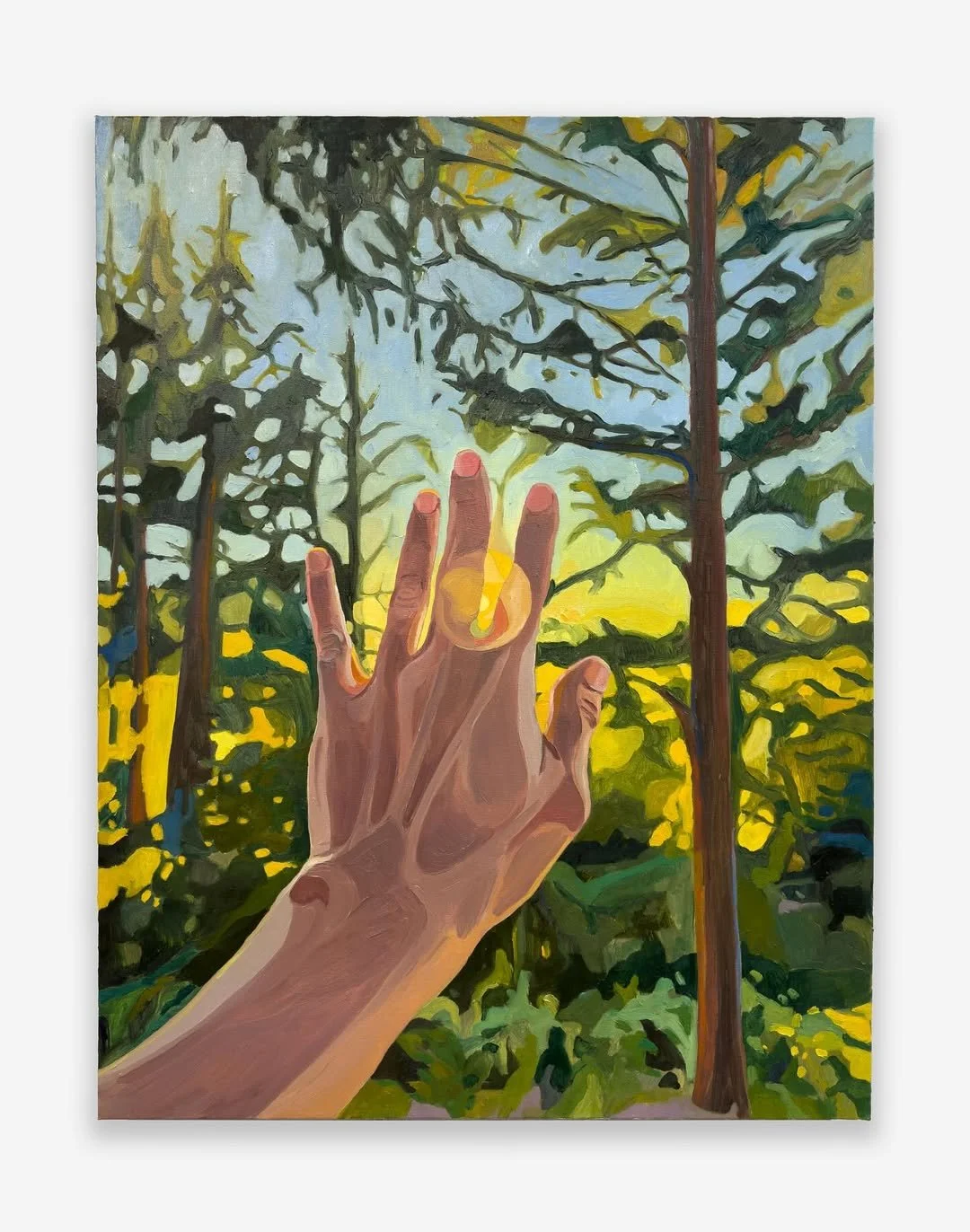
the hand in sharper relief than the distant trees, while the light that peeks through Tin’s index and middle finger shapes itself into an orb—a shape that is reminiscent of a lens flare, found in a photograph, which in turn makes one wonder if what is on canvas was never a scene, but a digital capture of a scene. Synchronicity with nature, then, isn’t just a matter of alignment between the sun and the self; rather, it is a triangulation between the sun, the self, and some other, third thing: mediation upon mediation, or perhaps just the idea of something already rehearsed—that one had to practice so it might be perfect.
I mention Tin’s hands because for the longest time, my visual reference to his No Straight Lines contribution was not a photograph of the painting, but a screenshot of an Instagram Story the artist had sent to the curator, with his same left hand—the one we see so splendidly in no longer a rehearsal—now making a V sign out from the same bottom-left corner, while the newer painting in question is hung on a wall.
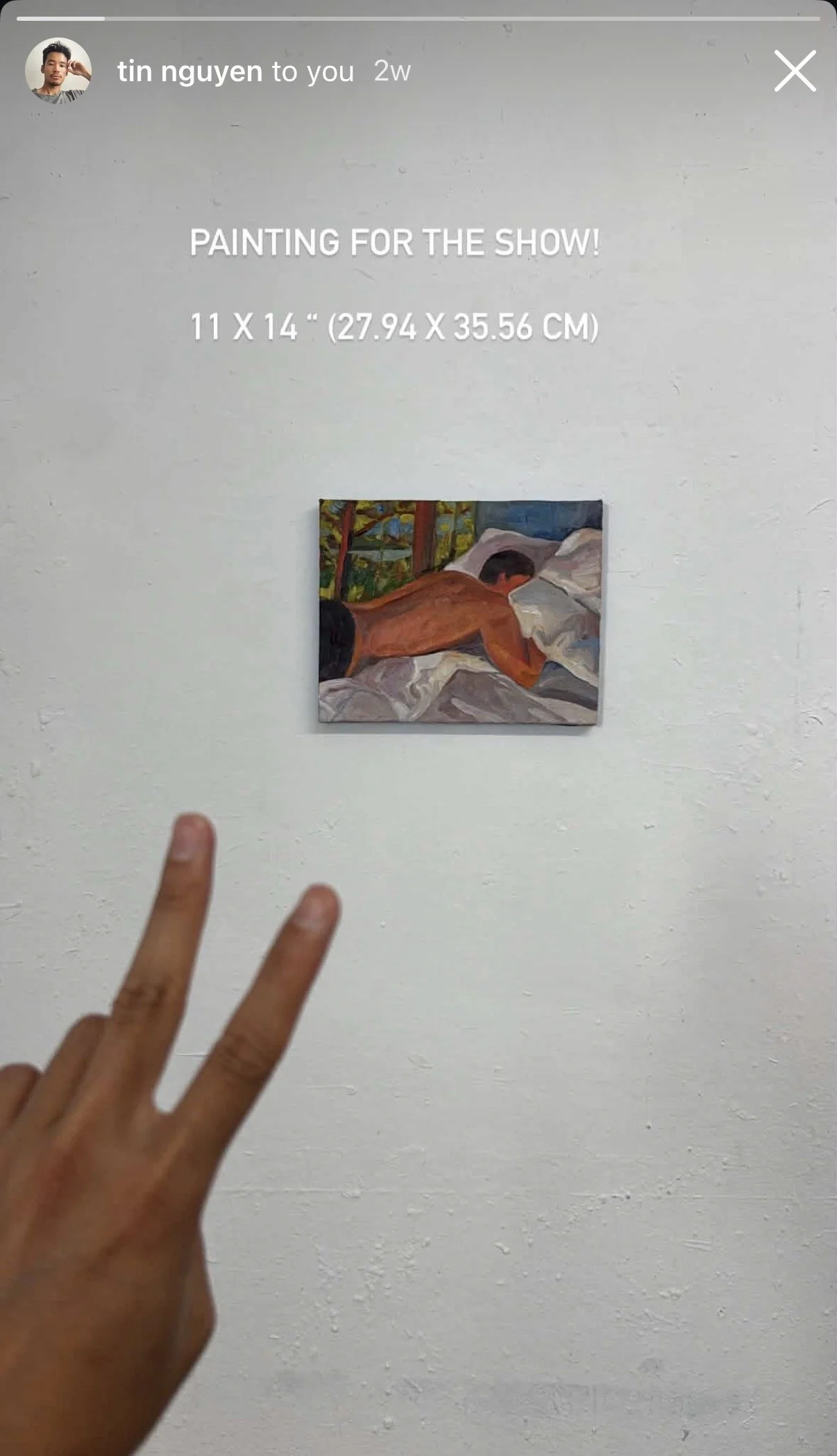
This is completely unintentional of the artist, but there was a mise en place in the various elements of the Instagram Story Tin sent to the curator that felt deeply resemblant of the composition we see in no longer a rehearsal, except now, of course, we are not in nature, but in the intimacy of someone’s abode, the subject of Tin’s new work a body on a bed, a body the artist has come to love. While on quiet summer afternoons like these, you asleep as the trees hum (2026) may be a study in miniature (measuring at a mere 11x14 inches), its disturbances feel more acute, especially when we consider the ambiguity of what we are seeing. The body could very be engaged in all manner of activities: it could be at rest, but it could also be in lust, but it could also, also, be in suffocation, in a denial of the senses, a rejection of whatever songs are streaming in from the outside, a desire to sleep the time but also the external away. Tin, did you know: even the V sign you make to your curator resembles a pair of scissors—as though the painting, at any moment, is at risk of being destroyed; as though the painting, about rest, can never be at rest.
05
to DYLAN HURWITZ
—I’m thinking now of Sara Ahmed, from her essay, “Orientations: Toward a Queer Phenomenology” (2006). She says: “Orientations are about how we begin, how we proceed from here. […] It is from this point that the differences between this side and that side matter.”
—Oh? I’m thinking now of Andrew Koh, who opens his novel, Glass Cathedral (1995), with this: “English. That was where I met him. In Italo Calvino’s Invisible Cities, to be precise.”
—Well. This is Sara, once again: “It is interesting to speculate what Butler might mean by ‘the field of heterosexual objects’… Heterosexuality in a way becomes a field, a space that gives ground to, or even grounds, heterosexual action through the renunciation of what is not, and also by the production of what it is.”
—And this is Andrew: “Producing children was a privilege, a sharing of the divine power, and therefore, only had to be used when two people, a man and a woman, were married in church… We got the message. Any sexual relationship outside the context of marriage was from the devil.”
—Sara: “In the conventional family home what appears requires following a certain line, the family line that directs our gaze… The queer couple in straight space might look like they are slanting, or oblique. The queer bodies, if they gather around the table, might even seem out of line. What happens if we consider the queer potential of the oblique?”
—Andrew: “I felt dizzy and breathless. I dragged myself to the bus stop… A young couple, hands entwined, walk past me, the woman stealing a furtive look. The spinning of reality amplified the grey of the pavement and the tarmac, stretching and folding them in on me, the myriad colours of the cars, buses, lorries, trees, grass.”
—Sara: “Even when orientations seem to be about which way we are facing in the present, they also point us towards the future.”
—Andrew: “But we have to be realistic; we have to be practical. There is no future for us here.”
—Sara: “We can think here about the alternative forms of world making within queer cultures and how they draw different kinds of lines, which do not aim to keep things in their places… A queer phenomenology might involve an orientation toward what slips, which allows what slips to pass, in the unknowable length of its duration.”
—Andrew: “I led [Norbert] on to our destination. As we neared the entrance of Centrepoint, I turned and saw James crossing the road, his right arm round the waist of a slender lady… I stared till they disappeared into the city crowds, and thought to myself, English. That was where I met him.”
—Sara: “We can find hope in what goes astray.”
—Andrew: “Why not? We’ll create our own future.”
06
to ALVIN ONG
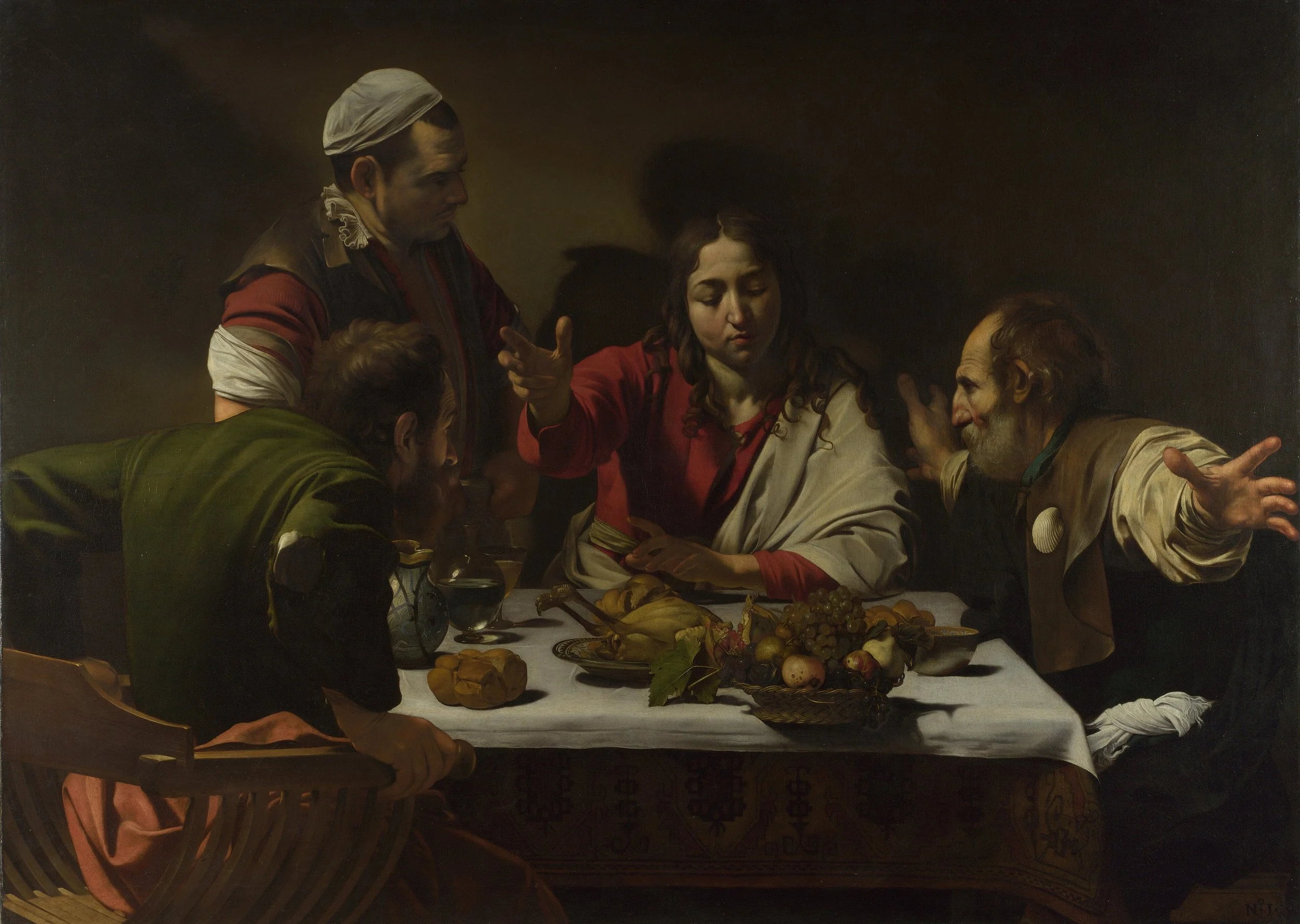
Perhaps I am not so good at comprehending chiaroscuro. Whose shadow is cast on the wall in Caravaggio’s The Supper at Emmaus (1610)? Does it belong to Jesus, whose own disappearance is imminent, or does it belong to the innkeeper—virtually absent in the Book of Luke, but whose presence on Caravaggio’s canvas has allowed swathes of darkness to be cast across the scene, darknesses that the Son of God might retreat into, maybe even return? I am tempted to ascribe the shadow to the innkeeper, whose querying gaze appears to literally form a backdrop against the drama at the dinner table, and whose function appears to be a surrogate for the everyman, and therefore act as a stand-in for the viewer of this painting, even if this character’s presence could be said to stretch edge to edge, like a cyclorama in a theatre. To love, and be loved; to remain peripheral, in the wings of one’s own story, as we allow someone else to inevitably stride into the spotlight: in the wayang kulit of our desire, I know what it means to pine to the point where one’s own ego must step aside, maybe even take a backseat, even as I insist on pressing my face, my torso against the other. But two can never become one, as hard as we might try. Do our eyes not resemble Caravaggio’s innkeeper the most? Softening but also sharpening while beholding the protagonist, on whom the locus of love resides, and on whom the light must therefore fall? Look at how the light falls constantly, for example, on other protagonists of the present moment: the artist Siew Guang Hong, born at the turn of the millenium, offering the image of his own body to the making of more proliferate images, consigning his anatomy to layers of manipulation, while Alfian Sa’at openly hopes, also at the turn of the millenium, in a postcard of a poem he sends towards the horizon: “In broad daylight two men holding hands / will mean nothing, but a symptom of daylight.” One must have found the twilight terrifying, at the beginning of time: Stay with us! warned Jesus’s devotees. It is nearly evening.
07
to LUCAS TAN
31 Jan
3.03pm: Heya how’s the new year
8.40pm: I kinda wanna pick ur brains for adult advice / It’s been a while / Many things have happened / I’m no longer a child / But a very weary soul
8.52pm: Lemme give you a tldr of / My break up in September
8.53pm: In a nutshell, he caught HIV when he was in Brazil for exchange back in 2022. I had warned him to use protection and if he caught HIV, I would break up with him. He did not listen to me. He begged me not to break up with him. It is not possible to work in SG as a hiv positive person. He got a job here without needing to test by miracle. Then he lost that job due to not fitting corporate hierarchy. He decided to move to Canada on a whim and kept pushing me to quit my job and apply for a phd. He then cheated on me in Canada and broke up with me on the first night I see him in 9 months during a group trip with friends and tried to pin the break up on me. Gave a lot of cruel and stupid reasons like I can only give him emotional support and he doesn’t need it often lmao.
20 Jun
2.48am: Forwarded from Ash Ali: [IMAGE OF SELFIE REDACTED] [IMAGE OF SELFIE WITH BICEP REDACTED] [IMAGE OF MIRROR SELFIE OF HEADLESS BODY AND ONE HAND COVERING ITS GROIN REDACTED] [VIDEO CLIP OF ERECT PENIS PLACED AGAINST ANOTHER’S ASS REDACTED] / SG NSFW LGBT SPA private social group. We’re all here to enjoy good vibes and share info + stories (no drama, no racism). This is a space for everyone within our community who loves a little adventure 💦 spread 🫂 not hate <https://[URL REDACTED]> All members here can now join this.
4.28am: omg bryan
8.52am: Nsfw lgbt
14 Aug
11.02am: I just saw a woman walk by with a tote bag that legit said / Well Bred Club.
11.03am: Happy for her / We should all aim to have good breeding.
08
to EKO BINTANG
EKO, EKO: YOU SAY THAT THE BODY CAN WITHSTAND MANY FORMS OF PLEASURE. YOU ALSO SAY THAT THE MIND CAN CONTAIN WORLDS WE CAN LOSE OURSELVES IN. EKO, DEAR EKO, WE ARE LARGE, YES, WE CONTAIN MULTITUDES, ONE HUNDRED PER CENT, BUT ALLOW ME TO SUPPLY YOU NOW WITH A NOTE ABOUT DREAMING, AND ABOUT THE INFRASTRUCTURE OF DREAMING THAT CAN TAKE PLACE IN THIS COUNTRY, WHERE NIGHT IS NOON AND NOON IS NIGHT, AND ALL THE LIGHTS ARE KEPT ON IN THE DARK: TO DREAM IS TO RISK WALKING IN ONE’S SLEEP, WHEREAS TO WAKE IS TO RISK NEVER KNOWING REST EVER AGAIN; EVERY ATOM BELONGING TO ME AS GOOD AS BELONGS TO THE STATE, BUT EVERY DREAM I WAKE UP FROM AS GOOD AS NEVER EXISTS. FIVE STARS MIGHT ARISE OUT OF A STORMY SEA, BUT I HAVE SEEN WITH MY OWN EYES THE DEPOPULATION OF A REPUBLIC, WHERE THE RIGHT TO DREAMING REQUIRES A WORK PERMIT, BUT ALSO WHERE THE P.S.F. TO FANTASY CONTINUES TO CLIMB LIKE THE SEAS. GOTTA KEEP ME MOVING, IS WHAT I GOTTA SAY, DEAR EKO; GOTTA KEEP ME LOVING (TO THE TOWN THAT’S RIGHT FOR ME)—THIS ONE IS EITHER ALWAYS DRAPING GAUZE OVER YOUR WEARY EYES OR TOO BUSY TRYING TO GIVE IT TO YOU UPSIDE DOWN. EKO: TO DREAM IS TO BE FUCKED OR TO BE LOST, YOU CHOOSE.
09
to CHA JIHOON
I’ve been debating over whether or not I should tell you a story about George, but I guess I’ll just go for it. He was the kind of man that once made my friend Sophia, on the bus to Kichijoji, burst out loud: “God, that man is beautiful.” And so it matters when I say that we too were friends, for a solid year, at least, the year we both spent in Tokyo: we had conveyor belt dinners at the Kappa Sushi nearby; gave each other massages; heard each other poop in toilet cubicles and assessed the state of our gut health and fibre intake. We formed a trio with another exchange student, a very blonde, very Swedish man named Johan: once, it was either Johan or George who had the idea to go camping near one of the five lakes around Mount Fuji in the middle of March, and although I refused to go with them, I made them recount to me, on the way back, how exactly it’d sounded when they went hiking along the expressway at the crack of dawn, and heard the frozen surface of a nearby lake begin to melt; later, during the warmer months, when I did think it was saner for us and a wider group of friends to camp in the same area, I remember how suddenly I’d steeped into a foul and sour sadness, like I was fifteen again, realising that the love I had for our friendship was far greater than his. It was the same kind of love I had for Oliver, and the same love I later had for Amrit, a platonic adoration that was too large for one person to hold, let alone two.
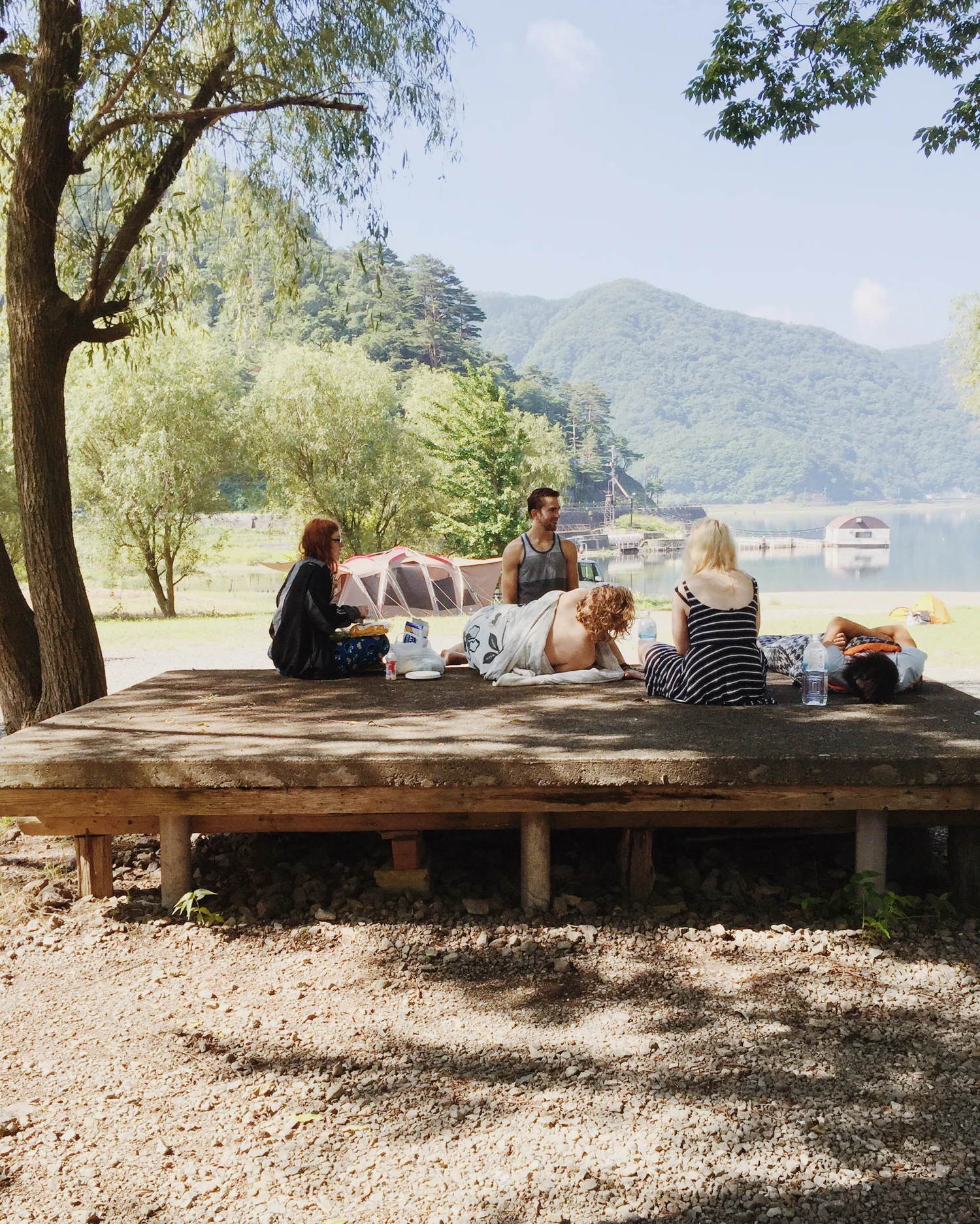
Anyway, the most important thing you should know is that once upon a time, when it was warm enough for everyone to drink in a circle in a park, George came to my defence when one of the girls made the rest declare via popular vote that I had the worst-looking penis amongst the boys. He said that they were wrong, that his was the worst, even though I know it to be untrue. Because once upon a time, I’d led our friend group on a weekly jog to the onsen nearest our dorm, which was the one south of Jindaiji: the peaches were ripe, there were matsuri to attend in Tokyo every other week, and on our final jog as a group we had to stop midway and marvel at how the neighbourhood had congregated around what we’d assumed was an abandoned shrine opposite the standalone 7-Eleven, dancing in a circle with flames and drums and much cheer; we then resumed our route towards the onsen, where I distinctly remember sitting in the main bath—there was just the one, exclusively outdoors—while Johan was in the cold tub (he was so Swedish!) and George was just standing by the door, waiting for the unexpected armada of local oji-san to finish using the line of showers: he was completely naked, with his hands on his hips and his cock on full display, while the expression on his face was bored, if not a little grouchy, when I’d looked over my shoulder, and our eyes made contact across the onsen. He had the kind of cock that’d made you say, unprompted and aloud, “God, that man is beautiful.” All this to say, again and again, for however long it takes for my love to wither out, that this man and I were friends, once upon a time.
10
to RICHIE NATH
—ko ko thett, in a poem: “how do you write history / in a language that has no / past tense?”
—Richie Nath, to the curator: “We are inundated with mythologies and fairy tales of heteronormative relationships; so we create our own imaginary versions using the pre-existing framework of traditional mythologies.”
—An interviewer, to Richie Nath: “What are some of your favourite things about art coming out of Myanmar?”
—Richie Nath, to the interviewer: “It’s hard to think about when all of the current news coming out of the country is turmoil and destruction.”
—The same interviewer, to Richie Nath: “In your opinion, what is something Europe can learn from Myanmar, concerning the arts?”
—Richie Nath, to the interviewer: “Nothing, actually, let it be a lesson of what not to do.”
—ko ko thett in another poem: “art is cheap, but not available to everyone…”
—Also ko ko thett, also the same poem: “…people are welcome, problems are not / living is expensive but dying doesn’t cost a dime.”
—Richie Nath, to the curator: “The work is a pondering of questions, on why we place power structures with specific sexual positions? Does it make it empowering that the coloniser is being portrayed as the passive in this scenario? Does it matter when, at the end of the day, the person that holds the most power is still the colonial officer? Does the story change when the active male figure is of South Asian descent? Considering the political climate of Rangoon at this time?”
—Me, to friends, over dinner, upon hearing the poet’s journey of self-exile: “Wow. Singaporeans really don’t know suffering.”
—ko ko thett, to me, at the same aforementioned dinner: “The point of suffering is not to compare.”
11
to NUNZIO MIANO
Perhaps I am not so good at comprehending figuration, either. Things are not so clear, and have never been clear, not since Ezra Pound described “the apparition of these faces in the crowd” as “petals on a wet black bough”; he himself once said that, in a poem like “In a Station of the Metro” (1913), “one is trying to record the precise instant when a thing outward and objective transforms itself, or darts into a thing inward and subjective.” For so many intermediaries can get in the way of one’s eyes when they fall upon a man’s visage: the hardening of one’s effeminacy, around the softness of one’s soul; the hardening of one’s muscles, into edges straight, clean, easier to hold; the hardening of one’s heart, against life’s many inequities. The neoliberal world we live in prescribes an equatorial condition, a harsh and humid tropicality: it can cause one’s idea, one’s wishes, one’s vision of the self to congeal and coagulate into something sticky, much like perspiration, an extraction from the body that nevertheless refuses to evanesce. The self therefore lingers, and laminates, into an outer shell that needs to be shed, and be rid of, something to be moulted and stripped away; the self becomes conscripted into the pornography of need and want and value and utility, and can only attempt to resist or entirely submit to be part and parcel of its plenitude. Every man I want now I compare and contrast to the man I first wanted, who taught me what it was to want: it’s not fair, what I’m doing, this is yet another one of life’s aforementioned inequities—and still he burns nonetheless, like the scar an eclipse might leave behind on one’s retina after staring at it for too long, or like a piece of clay I’ve forced into the fire, its glaze catching the light once I’ve got it in my hands. All this to say that some would rather remain one of many faces, a passerby in a metro station, while others will spend their whole lives chasing after a petal Pound once imagined.
12
to ROBERT MARTIN
Robert Martin has what I like to think of as an Annie Dillard state of mind. In their note to the curator, they say, and allow me to reproduce in full: “Spring in the upper Midwest can be slow to arrive, and it unfolds in stages. The arrival of skunk cabbage is [the] first beckoning of the season. As its spike emerges down close to the thawing earth it produces its own heat from energy converted from root starches, allowing it to pierce the compacted, ice-encrusted snow. Vibrant greens will begin to tuft the forest floor before ice has even broken from our lakes and ponds. By late April the fruit trees are beginning to bud, and the sun is warm enough to shed jackets and shirts. The rivers and streams swollen with snowmelt are notably frigid, but it’s hard to resist wading into the again-accessible waters to watch rusty crayfish dart between and beneath the rocks. Spring welcomes a freedom of being in the world—I’ve always associated it with the foundational experiences of boyhood. Following deer trails into the woods, building forts with branches broken from trees in their fragile dormancy, spotting frogs in the tannin-stained forest ponds, pissing freely on the last year’s decomposing leaves, and discovering the bones and shredded hides of animals claimed by the preceding harsh winter. Everything exposed by the thaw becomes nutritious fodder for the burgeoning rebirth. These vignettes offer an invitation into those atmospheres/experiences.”
My boyhood, on the other hand, was no Cythera. In the eternal sunshine of this island life, I think of springtime as that long passage across my own adolescence, when I got to go to the beach or the park or the reservoir from time to time, not because they were necessary, per se, but because they were seen to be excursions out of the everyday, which largely comprised of concrete, and tarmac, and the weird mouldable plastic of the school desks I’ve sat behind, pliable to the touch of a sharp pencil’s tip. I do remember, in vivid detail, the experience of being taken home, at the end of a school day: there was a long driveway where a fleet of school buses would park themselves— buses of all sizes, some more like vans, really—waiting for kids like me to get on board, and before the daily torment of being shuttled from one building to another could begin for me—knowing that the bullying would start the minute my bus got going, till the very second it was my turn to alight—I got to make my way down this very driveway, filled with vehicles and their open doors, and enjoy a profound boredom before the other boys could ruin it with their arrival and reintroduce their angst. In the briefness of this time, I became buoyed, almost, with the weightlessness that tends to come with waiting, waiting for things to get going, get moving, as they are constantly wanting to do nowadays—but a moment like the one I’m describing would last forever in my mind, however temporary it was in reality, for I was free, at last, from the necessity of defending myself against my childhood adversaries, and therefore free to do what I really wanted to do, which was to touch the mimosas that grew beside the pavement. They were plants that reminded me of me, feathery, delicate, gaudy, and sensitive, and therefore plants that I needed to say hi to, in my own way. In the springtime of my life, I see an outstretched finger in my mind’s eye, an index finger, the finger of a young boy, hoping to graze a leaf and watch it respond in kind, with its own clasping touch. In many ways, this boy was thinking: this touch, this response, was harmless, which was also how the boy had to construe as a form of kindness.
13
to AUGUST SIM
We know that every line is a circle: if we followed a straight path long enough we end up right where we belong. What does it mean, then, to live one’s life along these axes? To come to one end’s right where we’re beginning? I’m thinking, for example, of the first time I stepped into the curator’s home, exactly one year ago, and he had related a story behind a photograph, a story I knew to be true. But some memories are not mine to hold, while others I’ve learnt to cradle, to mine meaning out of them: for I’m thinking, now, of the way the curator’s own father had once asked him to move out of the place they lived in together, so as to cast the sight of him and his then-lover out of mind, only to ask—shortly after—when the two of them would be over for dinner. We all know this: that life works in ways that are strange, circuitous, roundabout, ungovernable. Why should desire? Why should love? For we all know this other maxim, don’t we, that love will always find its way: love is a circle is a cycle is a spiral; most lives, I like to think, spring forth from acts of love, which is to say: love makes life, and vice versa, I’m hoping. For love can also retract, as though it were allergic to the light; but love also knows to step into frame, or reach out, with a shaking and tender hand, once it realises that this brilliance is not something we haven’t already seen. It’s not something to be afraid of, and is exactly like what James Baldwin once wrote: “Love brought you here. If you trusted love this far, don’t panic now.” For this is the meaning I’ve been trying to reach, and I’m wondering if you’ve gotten this by now, just as we’ve started to circle back to one another: while we were moving around the curator’s home, did you not come to the realisation that love has been everywhere—this whole time, in fact! For let me tell you one final, all-too-obvious thing: that it was love that built this home; and that it took sacrifice and labour in order to make this love evident; and as we inhabit its minor realms, and meander along its manmade paths, tell me, please, how we might one day leave behind our parlours and boudoirs of knowledge and beauty, and dare to venture down that queer corridor, travailing, ever-looping, towards a higher understanding, and perhaps a greater dreaming.
Oct 2026
REFERENCES
In 01:
Chrystal Ho. “The Woman in the Locket”, from Elsewhere, the Cosmos Cracks. 2025.
Gerald Giam. “Constitution of the Republic of Singapore (Amendment) Bill & Penal Code (Amendment) Bill—Speech by Gerald Giam.” Delivered in Parliament on 28 Nov 2022. <https://www.wp.sg/parliament/constitution-of-the-republic-of-singapore-amendment-bill-penal-code-amendment-bill--speech-by-gerald-giam>
Grace Fu. “I've been following conversations around development plans for Maju forest & Gillman Barracks, and would like to share some thoughts.” Instagram, 7 Aug 2022. <https://www.instagram.com/p/Dbu7ntaiWn0/>
Lakeisha Leo. “Timeline: Repealing Section 377A and amending the Constitution to protect the definition of marriage”. Channel News Asia, 28 Nov 2022 08:46AM (Updated: 29 Nov 2022 07:35PM). <https://www.channelnewsasia.com/singapore/timeline-repealing-377a-gay-sex-law-amending-singapore-constitution-marriage-definition-3101551>
Lee Hsien Loong. “National Day Rally 2022.” 21 Aug 2022. <https://www.pmo.gov.sg/newsroom/national-day-rally-2022-english/>
Ng Jun Sen. “377A will be around ‘for some time’, will not inhibit how S’pore attracts tech talent: PM Lee”. Channel News Asia, 26 Jun 2019 10:31PM (Updated: 27 Jun 2019 09:54AM). <https://www.channelnewsasia.com/singapore/377a-will-be-around-some-time-will-not-inhibit-how-spore-attracts-tech-talent-pm-lee-5704681>
Tan Seng Kee v Attorney-General and other appeals [2022] SGCA 16 <https://www.elitigation.sg/gd/s/2022_SGCA_16>
Thio Li Ann. “Full transcript of NMP Professor Thio Li-Ann’s speech in Parliament (October 2007)”. The Online Citizen. <https://cdn.theonlinecitizen.com/uploads/2014/12/27011220/Parlimentary-transcript-NMP-Prof-Thio-Li-Ann-Oct-2007.pdf>
William Shakespeare. Hamlet. 1599-1601.
William Shakespeare. Romeo and Juliet. 1597.
In 02:
Alex Chilton. “Kangaroo”, from The Mortal Coil, It’ll End in Tears. 1984.
Cassandra Jenkins. “Hard Drive”, from Cassandra Jenkins, An Overview on Phenomenal Nature. 2021.
Justin Vernon. “Blindsided”, from Bon Iver, For Emma, Forever Ago. 2007.
Phoebe Bridgers. “Funeral”, from Phoebe Bridgers, Stranger in the Alps. 2017.
Stevie Nicks. “Silver Springs”, from Fleetwood Mac, Almanac. 1978.
In 03:
O Thiam Chin. Love or Something Like Love. 2013.
In 04:
Tin Nguyen. “Happy Equinox 🌞🌞 !!! “How Nice To Not Rush” is opening up next Friday, March 27th at @auxierkline 💛 Every time I let myself be met by the earth, my heart opens so much. I’m so happy to share this next body of work with you all.” Instagram, 20 Mar 2026. <https://www.instagram.com/p/DWHCiFMjjwB>
In 05:
Andrew Koh. Glass Cathedral. 1995.
Sara Ahmed. “Orientations: Toward a Queer Phenomenology”, from GLQ: A Journal of Lesbian and Gay Studies, Volume 12, Number 4, 2006. <https://muse.jhu.edu/article/202832>
In 06:
Alfian Sa’at. “Anthem”, from The Invisible Manuscript. 2012.
Caravaggio. The Supper at Emmaus. 1601.
In 10:
ko ko thett. “A Walk with History”, from The Burden of Being Burmese. 2015.
ko ko thett. “Chaos Clock”, from Warscapes. 2012.
In 11:
Ezra Pound. “In a Station of the Metro”, from Poetry, April 1913.
Ezra Pound. “Vorticism”, from Gaudier-Brzeska. 1916.
In 13:
James Baldwin. If Beale Street Could Talk. 1974.